24 Nov 2026
The vessel arrives on schedule. Your equipment clears the terminal. The installation team is ready.
Then someone discovers that the loaded trailer cannot use the bridge on the planned route.
For a business moving a transformer, production line or oversized machine, this is more than a transport delay. It can mean idle cranes, waiting contractors and a postponed start to operations.
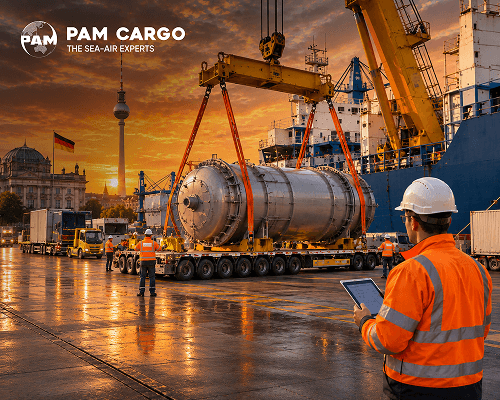
Project Cargo Handling in Germany requires planning around the complete journey, including the turns, transfers and unloading arrangements that a freight quote may not explain. Here are the challenges worth addressing before your equipment leaves the factory.
A machine’s manufacturing dimensions are not always its shipping dimensions. Packing, protective frames, lifting attachments and transport supports can increase its size and weight.
That difference matters when selecting a trailer, checking overhead clearance or preparing a lifting plan.
Before requesting transport quotations, prepare a cargo information sheet covering:
Use the same approved information across every booking and document. If the packing arrangement changes, tell the transport team before collection.
A few centimetres added at the factory should never become a surprise at a bridge.
A route that works for ordinary freight may be impossible for a heavy or oversized load. Bridge capacity, roadworks, turning space, overhead structures and access to the delivery site all affect the journey.
Germany’s infrastructure restrictions can also change. For example, Hamburg Port Authority announced that permit-required heavy transports exceeding 44 tonnes would be diverted away from the Köhlbrand Bridge from 1 May 2026. That is a practical reminder to check current conditions instead of relying on a route used for an earlier shipment.
Ask for route feasibility to be checked before committing to the shipping plan. For complex movements, this may require a physical route survey.
Include the final approach to the site. A motorway journey can go perfectly, only for the truck to reach an entrance that is too narrow.
Booking a heavy-duty trailer does not mean the road movement is approved.
Germany uses VEMAGS for the application and approval process for large and heavy transports. The competent authorities issue approvals, while Autobahn GmbH assesses the suitability of motorway sections within its responsibility.
The application needs accurate route and vehicle information. Relevant details include dimensions, axle loads and total weight. Depending on the movement, approvals may carry additional conditions. Hamburg’s official guidance also notes that bridge calculations and consultations involving other states can extend processing times.
Build the schedule around confirmed requirements. Ask who owns the application, what information remains outstanding and whether a change of trailer or route would require an amendment.
Avoid promising a fixed delivery date while these questions remain unanswered.
Project cargo may move between a vessel, terminal, barge and road trailer before reaching its destination. Each transfer introduces another lifting operation and another team.
The question is not simply whether a crane can lift the stated weight. The lifting arrangement must account for working radius, rigging, load distribution and the manufacturer’s handling instructions.
Have the appointed specialists confirm lifting and securing arrangements before dispatch. Establish who supplies lifting accessories, who supervises the operation and who records the cargo’s condition at each handover.
Clear photographs taken before loading and after discharge can help resolve disagreements about when damage occurred.
A location update can tell you where a shipment is. It may not tell you whether the next movement is ready.
When choosing our Cargo Tracking Service in Germany, ask what the updates actually cover. For project shipments, useful reporting should distinguish between:
For example, “arrived at the port” is incomplete information if collection cannot begin.
Agree on a named contact and an escalation process. When a milestone slips, the receiving team needs enough notice to adjust crane bookings, labour and site access.
A delivery address is not an unloading plan.
Before dispatch, confirm the gate dimensions, turning area, ground conditions and space needed for the unloading equipment. Check whether other contractors will occupy the same area and whether the cargo must arrive in a particular sequence.
Ask the site team to approve the delivery arrangement in writing. Include an alternative holding location if the equipment cannot be received as planned.
This is especially useful when several components are arriving separately. Delivering the wrong piece first can create extra handling and block the space needed for installation.
A useful project cargo quotation should explain its assumptions: cargo measurements, route, handling arrangements, waiting time and the work included in the price.
Before selecting a provider, ask: What could stop this shipment, and what have we checked to prevent it?
Planning a Project Shipment to or from Germany? Share your cargo drawings, packed dimensions, weight, collection point and delivery schedule with PAM Cargo to discuss your requirements. The earlier those details are available, the sooner potential problems can be identified.
AWARDS & RECOGNITIONS
Committed to Excellence, Every Step of the Way


Swiss WorldCargo Best Tonnage Producer 2025
PAM Cargo has been recognized by Swiss WorldCargo as Best Tonnage Producer 2025, acknowledging our strong cargo performance, outstanding tonnage contribution, and continued partnership with Swiss WorldCargo.


